Unlock Your Business Potential: A Founder's Guide to the Business Model Canvas
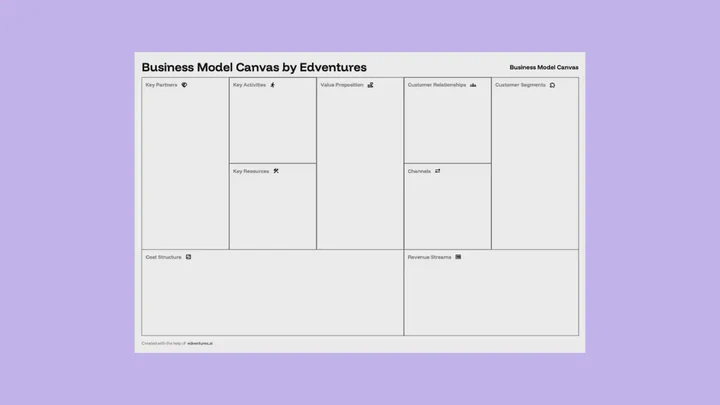
Design by Edventures
Many early-stage founders find themselves struggling to articulate their business idea clearly, let alone validate its potential. It’s a frustrating cycle – a spark of an idea, a flurry of activity, and then… uncertainty. Why isn’t it resonating? What assumptions are we making? The Business Model Canvas offers a powerful framework to break through this fog, providing a shared language and a visual map for your business journey. This isn’t just another template; it’s a living document that, when used effectively, can be the bedrock of your strategic planning and ongoing business development.
A Brief History: From Lean Startup to Global Adoption
The Business Model Canvas, as we know it, is the brainchild of Alexander Osterwalder. Prior to its popularisation, business planning often involved sprawling, complex documents that were more cumbersome than helpful. Osterwalder, frustrated with the traditional approach, sought a more visual, concise, and actionable alternative. His initial work, alongside Yves Pigneur, resulted in “Business Model Generation,” published in 2010, which introduced the canvas to a wider audience. It quickly gained traction within the Lean Startup movement, aligning perfectly with its emphasis on rapid experimentation and customer feedback. The canvas’s simplicity and adaptability have since led to its widespread adoption across industries and business stages, from startups to established corporations. It’s a testament to the power of a well-designed framework – one that doesn’t dictate, but rather facilitates understanding and strategic thinking.
Edventures: Coaching Founders with the Canvas
At Edventures, we don’t just teach the Business Model Canvas; we live it. Our AI-powered coaching platform, Anna, leverages the canvas as a core diagnostic and planning tool. Anna doesn’t simply ask generic questions; she guides founders through each element of the canvas, prompting them to articulate their assumptions, identify potential risks, and explore opportunities. For example, if a founder is struggling to define their Value Proposition, Anna might ask targeted questions about their customer’s pain points, the unique benefits they offer, and how they differentiate themselves from competitors. This isn’t a passive exercise; it’s an interactive dialogue designed to challenge assumptions and uncover hidden insights.
The canvas serves as a baseline for our coaching sessions. It provides a shared understanding of the business model, allowing us to quickly identify gaps and areas for improvement. A founder might initially believe their Customer Segments are broad and diverse, but through a guided discussion and data analysis (integrated within Anna), they might realise their ideal customer is much more niche and specific. This clarity allows for more targeted marketing efforts, a more focused product development roadmap, and ultimately, a higher chance of success. We’ve seen firsthand how this structured approach can transform a vague idea into a concrete plan, and a hesitant founder into a confident leader.
Deconstructing the Canvas: A Practical Guide
Let’s break down each element of the Business Model Canvas and explore how you can leverage it to build a stronger business.
- Customer Segments: Who are you serving? Be specific. Don’t just say “everyone.” Are they consumers, businesses, or a combination? Consider demographics, psychographics, and behaviours. Example: Instead of “small businesses,” try “independent coffee shops in urban areas with a focus on sustainability.”
- Value Propositions: What problem are you solving for your customer segments? What unique benefit do you offer? This is the core of your business. Example: For the coffee shop example, your value proposition might be “providing ethically sourced, high-quality coffee beans and equipment, along with expert training, to help independent coffee shops thrive in a competitive market.”
- Channels: How will you reach your customers? Consider online channels, retail stores, partnerships, and direct sales. Example: A combination of online advertising, industry events, and partnerships with coffee equipment suppliers.
- Customer Relationships: What type of relationship will you establish with your customers? Personal assistance, self-service, automated services, communities? Example: A blend of online support forums, personalised email marketing, and occasional in-person workshops.
- Revenue Streams: How will you make money? Sales, subscriptions, advertising, licensing? Example: Sales of coffee beans and equipment, subscription-based training programs, and potential licensing of proprietary blends.
- Key Activities: What are the most important things you need to do to make your business model work? Example: Sourcing high-quality coffee beans, developing training materials, managing online sales, and providing customer support.
- Key Resources: What assets do you need to deliver your value proposition? Physical assets, intellectual property, human resources, financial resources? Example: Relationships with coffee farmers, proprietary roasting techniques, a skilled training team, and a robust online platform.
- Key Partnerships: Who do you need to work with to make your business model work? Example: Coffee farmers, equipment suppliers, logistics providers, and marketing agencies.
- Cost Structure: What are the most important costs inherent in your business model? Fixed costs, variable costs, economies of scale? Example: Cost of coffee beans, salaries, marketing expenses, and platform maintenance.
Beyond the Template: A Living Document
The Business Model Canvas isn’t a one-and-done exercise. It’s a living document that should evolve alongside your business. As you gather customer feedback, test your assumptions, and enter new markets, you need to revisit and revise your canvas. This iterative process is crucial for ensuring that your business model remains relevant and sustainable.
Imagine launching your coffee shop equipment business and discovering that your initial target audience – independent coffee shops – are primarily interested in used equipment due to budget constraints. This feedback necessitates a significant shift in your Value Proposition and Channels – perhaps offering refurbished equipment or focusing on a different segment of the market. The canvas allows you to quickly visualise these changes and adjust your strategy accordingly.
Anna, our AI coach, actively encourages this iterative approach. She prompts founders to regularly review their canvas, identify areas for improvement, and track the impact of their changes. She can even analyse market data and competitor activity to provide insights that might otherwise be missed. This continuous feedback loop is what separates a static business plan from a dynamic, adaptable business model.
From Idea to Execution: The Edventures Advantage
We’ve seen founders come to us with brilliant ideas but lacking the structure to translate them into reality. The Business Model Canvas, combined with Anna’s personalsed guidance, provides that framework. It’s not just about filling out boxes on a template; it’s about critically examining your assumptions, validating your ideas, and building a business that is both sustainable and scalable.
Consider a founder who initially believed their subscription box service for artisanal dog treats would appeal to all dog owners. Through the canvas exercise and customer interviews facilitated by Anna, they discovered that their ideal customer was a specific niche: affluent urban dwellers who prioritise organic, ethically sourced products for their pets. This targeted approach allowed them to refine their marketing efforts, optimise their product selection, and achieve a much higher customer acquisition rate.
The canvas isn’t a magic bullet. It requires honest self-reflection, a willingness to challenge assumptions, and a commitment to continuous improvement. But when used effectively, it can be a powerful tool for unlocking your business potential.
Test Your Potential: Start Building Today
The Business Model Canvas is readily accessible online – you can find numerous free templates and resources. However, to truly harness its power, you need a structured process and ongoing support. That’s where Edventures comes in.
We invite you to explore our platform and experience the difference that AI-powered coaching can make. Start by sketching out your own Business Model Canvas – don’t strive for perfection, just focus on getting your ideas down on paper. Sign up for a free account on our platform and let Anna guide you through the process, challenging your assumptions and helping you build a business that is both innovative and sustainable. Your entrepreneurial journey starts now.